

Introduction
As tabletop games grow more sophisticated, players are often asked to manage increasing amounts of information while still maintaining immersion and flow. This challenge is particularly evident in air combat tabletop games, where decision-making frequently depends on consulting multiple tables, cross-referencing rules, and remembering situational modifiers. While this depth is part of the genre’s appeal, it can also slow down gameplay and create a steep learning curve for new players.
To address these challenges, we held a meeting with a key stakeholder to better approximate the design of an embedded device intended for use during tabletop gaming sessions. The goal of this device is to support players by providing pre-made lookups, contextual tips, and decision-making aids, reducing the need for constant rulebook consultation without altering the core mechanics of the game.
This interview explores the stakeholder’s perspective on player needs, usability constraints, and design priorities, with a specific focus on how an embedded system can enhance the experience of an air combat tabletop game while preserving its strategic depth.
Approximating the Design of an Embedded Assistant for an Air Combat Tabletop Game
Interviewer: Thank you for meeting with us today. To begin, could you briefly describe your role in relation to the air combat tabletop game?
Flavio: Certainly. I am the Italian coordinator for a highly realistic World War II air combat tabletop game. I coordinate a group of players by organizing live combat sessions twice a month and running ongoing play-by-mail games. I also create and adapt scenarios, prepare game materials, and help new players learn the rules and basic tactics of the game. In addition, I attend conferences and conventions focused on historical wargames to promote the game and share knowledge about how it is played. Because I am directly involved in these activities, I can closely observe how players use the rules during real game sessions.
Interviewer: From your experience, what are the main challenges players face during gameplay?
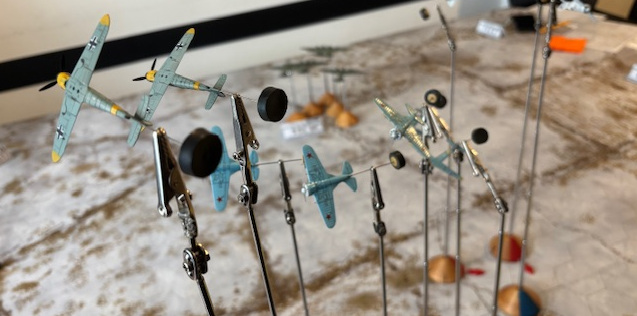
Flavio: The biggest challenge is information management. Air combat games are inherently complex: altitude, speed, weapon loadouts, damage states, and positioning all interact. Players often need to consult multiple tables to resolve a single action. While experienced players can handle this, newcomers tend to lose momentum, and even veterans can experience fatigue during long sessions.
Interviewer: How does this table lookup intensity affect the overall game experience?
Flavio: It disrupts the flow. Instead of focusing on tactics and narrative like anticipating an opponent’s maneuver, players spend time flipping pages or double-checking modifiers. This can break immersion and make the game feel more like an administrative task than a dynamic air combat simulation.
Interviewer: The proposed embedded device aims to address these issues. What value do you see in such a tool?
Flavio: I see it as a way to offload cognitive effort without simplifying the game itself. If a device can instantly provide the correct lookup, or suggest relevant considerations based on the current game state, players can stay engaged in decision-making rather than rule management. Importantly, it should assist, not automate, the player’s choices.
This aspect is particularly important for attracting new players. Most people who approach the hobby do so through simple or medium-complexity games, and are generally intimidated by the amount of information required to play more complex titles. This tool could help bridge that gap and encourage new players to try more complex games.
Interviewer: Can you give an example of how this device might be used during a typical turn?
Flavio: For example, when a player declares a maneuver, the device could immediately display the applicable table results based on aircraft type, speed, and altitude. It might also highlight tactical tips, such as energy loss risks or common follow-up options. This kind of contextual assistance would significantly reduce downtime.
Interviewer: What kind of information should the device prioritize displaying?
Flavio: Accuracy and relevance are key. It should show only what the player needs at that moment, no clutter. Core lookups, conditional modifiers, and brief reminders of rule interactions are ideal. Long explanations or full rule text would be counterproductive during play.
Interviewer: Are there any concerns regarding the use of an embedded device at the table?
Flavio: Yes, primarily around usability and fairness. The interface must be intuitive and fast; any delay defeats the purpose. Additionally, it’s important that all players have access to the same information, so the device doesn’t create an advantage or feel like “cheating.” Transparency is essential.
Interviewer: How important is the physical form factor of the device in a tabletop setting?
Flavio: Very important. It should fit naturally on the table, not dominate it. A small screen, minimal controls, and clear visual hierarchy would work best. The device should feel like a tool not like a distraction.
Interviewer: From a design perspective, what would define success for this project?
Flavio Success would mean faster turns, fewer rule interruptions, and more player engagement. If players finish a session feeling mentally invested rather than mentally exhausted, the device has done its job. Ideally, it should also help new players learn the game more organically.
Interviewer: Do you see potential for this concept beyond air combat tabletop games?
Flavio: Absolutely. Any tabletop game that relies heavily on tables, modifiers, or conditional logic could benefit from a similar approach. The key is respecting the original game design while enhancing accessibility and flow.
Interviewer: Let’s move to more practical aspects of the device. From your point of view, how big should it be to work well on a gaming table?
Flavio: [Showing a POS device] About this size should be suitable for all players. It is small enough to fit on the table without taking too much space, but large enough to be easily seen during the game. A device of this size feels familiar and practical, especially in a shared tabletop environment.

Interviewer: What about the display? How large should it be to remain readable during play?
Flavio: The display should be large enough for prompting and show key values clearly, without forcing players to lean forward. A screen in this range allows text and numbers to be read from different positions around the table. Readability is more important than high resolution; clear fonts and good contrast matter more.
Interviewer: You mentioned the viewing angle. Can you explain why this is important?
Flavio: Yes. The display should be tilted at about a 60-degree angle and be self-standing. This allows players sitting around the table to read the information easily without moving the device. A fixed, stable angle also prevents the device from being handled too much, which helps keep the game flowing smoothly.
Interviewer: Let’s talk about the buttons. How many keys do you think are suitable for this kind of game?
Flavio: Fewer keys are better, but not so few that the device becomes difficult to use. We definitely need a way to enter numbers, for example when changing altitude. The types of information entered by the player are always the same, so the same keys could be reused for different functions. A simple nested menu could help manage this without adding too many buttons.
Interviewer: So, for example, we could have ten number keys for the values used most often, one ENTER or CONFIRM key, one DELETE or BACK key, four arrow keys to move inside menus, and maybe four extra keys available if needed. How does that sound to you?
Flavio: Yes, roughly like that. It sounds reasonable, but I would like to take a few days to think about it and confirm. We want to be careful not to end up with too few keys, especially as the system grows.
Interviewer: We were thinking about a rechargeable battery that lasts at least 8 hours.
Flavio: Yes, that would be suitable. Our longer sessions during events can last that long, so an 8-hour battery would cover a full day of play.
Interviewer: What about the information displayed on the screen? Do you see a better or more practical way to organize it?
Flavio: Yes. For our game, it would be useful to divide the screen into clear sections. The top section could show the current status of the aircraft, such as speed, altitude, and damage. The bottom section could show the expected aircraft status at the end of the turn, after all actions are applied. The middle section should be used for prompts and player actions, where the device asks for inputs or suggests the next steps.
Interviewer: Flavio, in your opinion, how much should a device like this cost? What is a price that an enthusiast would be willing to spend to build such a device?
Flavio: I think that between €50 and €100 would be an affordable price for most players. Of course, enthusiasts like me might be willing to spend more for a customized product.
Interviewer: Thanks a lot, Flavio, for sharing this behind-the-scenes perspective on board games and how this device can make the experience better. Don’t forget that you can keep up with the progress on this blog!